Monday, 11 November 2024

Computer Numerical Control Machines Market Report: The Impact of Industry 4.0

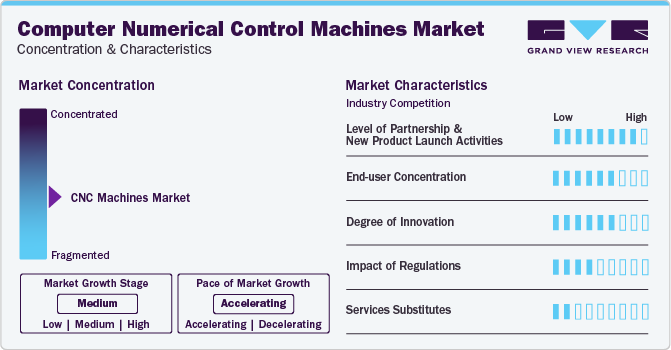
 The global computer numerical control (CNC) machines market is experiencing significant growth, projected to reach a value of USD 66.74 billion in 2023. This market is poised to expand at a Compound Annual Growth Rate (CAGR) of 10.3% from 2023 to 2030. The widespread adoption of CNC machines can be attributed to their ability to automate manufacturing processes, execute complex tasks with precision, and reduce human error and labor costs. These machines can operate continuously, improving productivity and efficiency in industries such as automotive, aerospace, and electronics.


In 2022, the CNC machines market witnessed a strong recovery due to increased machine orders from North America, Asia Pacific, and Europe. This growth was fueled by pent-up demand and backlog orders resulting from the pandemic. Furthermore, technological advancements are driving the growth of CNC machines. These machines are becoming increasingly sophisticated with features like multi-axis capabilities, improved spindle speeds, advanced tooling options, and real-time monitoring systems. The integration of IoT and AI technologies further enhances their capabilities, enabling predictive maintenance, adaptive machining, and data-driven optimizations.


End-use Segmentation Insights 


The industrial segment was the largest market segment in 2022, accounting for approximately 26.0% of the market share. The increasing adoption of CNC machines in the industrial sector is driven by the need for greater automation and improved efficiency. CNC machines can perform complex manufacturing tasks with minimal human intervention, leading to increased productivity and reduced production times. The industrial segment encompasses various manufacturing industries such as packaging, electronics, medical, and others. The growing demand for fully automated and turnkey CNC machines, aimed at addressing production backlogs from 2020, is expected to drive segment growth over the forecast period.


The automotive sector is projected to experience the highest CAGR of nearly 12.0% over the forecast period. The automotive sector has always been at the forefront of technological advancements, driven by the pursuit of precision, efficiency, and innovation. The increasing popularity of electric vehicles (EVs) and the rising demand for ultra-precision parts for EVs are expected to positively impact the growth of the automotive segment. The increasing demand for customized automotive components such as crankshafts, cylinder heads, and motor pumps is also expected to contribute to market growth. As a result, the automotive sector's need for CNC machines is anticipated to drive segment growth over the forecast period. 

Order a free sample PDF of the Computer Numerical Control Machines Market Intelligence Study, published by Grand View Research.

Wednesday, 30 October 2024

Electric Motor Sales Market: Shifts in Consumer Preferences and Applications

The global electric motor sales market was valued at USD 182.65 billion in 2023 and is projected to grow at a compound annual growth rate (CAGR) of 8.5% from 2024 to 2030. This growth is primarily driven by increased awareness of green vehicles among consumers and supportive government policies encouraging the adoption of environmentally friendly technologies.


Electric motors have undergone significant technological advancements in recent years, leading to improved efficiency, longer lifespan, and better performance. The availability of advanced insulation materials has further contributed to these improvements. The rising demand for electric vehicles and the increasing production of automobiles are expected to drive the market growth during the forecast period. 


Gather more insights about the market drivers, restrains and growth of the Electric Motor Sales Market


Electric motors find wide applications in various sectors, including fans, pumps, compressors, machine tools, domestic appliances, electric cars, HVAC systems, power tools, and automated robots. High-efficiency motors are particularly sought after due to their long operating life, low maintenance requirements, energy efficiency, and tolerance for voltage fluctuations.


Countries like Brazil, the U.S., Argentina, China, and India are major markets for electric motors, with a strong focus on energy-efficient products in both industrial and agricultural sectors. 


Power Output Segmentation Insights


The Fractional Horsepower (FHP) output segment was the dominant force in the market in 2023, capturing a substantial revenue share of over 86.0%. This dominance can be attributed to the versatility of FHP motors, which find applications in a wide range of household appliances, from vacuum cleaners to coffee machines and refrigerators. Additionally, their suitability for heavy industrial environments has led to their adoption in industrial equipment. FHP motors offer several advantages, including high starting torque and the ability to maintain stability despite fluctuations in electric current.


Moreover, the energy efficiency of FHP motors surpasses that of other motor types, making them an attractive option for industrial users seeking to replace existing machinery with more efficient alternatives.


While the FHP segment holds a significant market share, the Integral Horsepower (IHP) output segment is projected to experience the highest Compound Annual Growth Rate (CAGR) from 2024 to 2030. This growth is driven by the increasing demand for IHP motors in industrial applications. These motors deliver higher power output, making them suitable for high-end applications in industries such as aerospace and transportation. 


Order a free sample PDF of the Electric Motor Sales Market Intelligence Study, published by Grand View Research. 

Thursday, 24 October 2024

Computer Numerical Control Machines Market: Customer Demands and Technological Advancements


Computer Numerical Control Machines Market


The global market for computer numerical control (CNC) machines is experiencing significant growth, driven by their ability to automate and streamline manufacturing processes. In 2023, the market value reached USD 66.74 billion, and it is projected to expand at a compound annual growth rate (CAGR) of 10.3% through 2030. The increasing adoption of CNC machines is attributed to their precision, consistency, and efficiency in executing complex tasks. By automating manufacturing processes, CNC machines reduce human error, labor costs, and downtime, leading to improved productivity and efficiency in industries such as automotive, aerospace, and electronics.


The CNC machines market experienced a strong recovery in 2022, fueled by increased machine orders from various regions, particularly North America, Asia Pacific, and Europe. The pent-up demand and backlog orders resulting from the pandemic contributed to the positive growth in 2022. Furthermore, technological advancements are playing a crucial role in driving the growth of CNC machines. These machines are becoming more sophisticated, incorporating features like multi-axis capabilities, higher spindle speeds, advanced tooling options, and real-time monitoring systems. The integration of Internet of Things (IoT) technology and Artificial Intelligence (AI) further enhances the capabilities of CNC machines, enabling predictive maintenance, adaptive machining, and data-driven optimizations.


Gather more insights about the market drivers, restrains and growth of the Computer Numerical Control Machines Market


Type Segmentation Insights


Based on the type of machines, CNC lathe machines held the largest market share, accounting for over 28.0% in 2022. The growth of this segment is expected to be driven by the increasing demand from the automotive sector. This demand is fueled by the need to manufacture customized parts like cylinder heads, gearboxes, starter motors, and for prototyping applications. Additionally, technological advancements in existing CNC lathe systems are expected to contribute positively to the segment growth. The incorporation of new features to cater to diverse applications will further enhance the segment's potential.  


On the other hand, CNC milling machines are anticipated to experience the highest CAGR of nearly 12.0% during the forecast period. The global growth of milling machines can be attributed to factors such as the growing emphasis on industrial automation and technological advancements. The emergence of Industry 4.0 and the integration of advanced technologies like artificial intelligence, machine learning, and robotics have transformed milling machines into intelligent and efficient tools capable of executing intricate tasks. Automation reduces the need for human intervention, leading to increased productivity, enhanced accuracy, and seamless integration within manufacturing processes.


Order a free sample PDF of the Computer Numerical Control Machines Market Intelligence Study, published by Grand View Research.

Sunday, 20 October 2024

Electric Motor Sales Market Innovations Driving Efficiency and Performance

 The global market for electric motors is experiencing significant growth, driven by a combination of factors. The market size was valued at USD 182.65 billion in 2023 and is projected to expand at a compound annual growth rate (CAGR) of 8.5% from 2024 to 2030. Several key factors are contributing to this growth.


One of the primary drivers is the increasing awareness among consumers about the benefits of green vehicles. As people become more conscious of the environmental impact of traditional vehicles, they are increasingly opting for electric alternatives. This trend is further supported by government incentives that encourage the purchase of electric vehicles. These incentives, aimed at reducing carbon emissions, are expected to provide a significant boost to the market.


Technological advancements in electric motors have also played a crucial role in driving demand. Over the past few years, there have been notable improvements in motor technology, leading to enhanced performance and efficiency. Better insulation materials have contributed to increased operational efficiency and longer product life, making electric motors more attractive to consumers and businesses.


The growing production of automobiles is another factor fueling the market for electric motors. As the demand for cars continues to rise, so does the need for electric motors to power them. This trend is expected to drive significant growth in the market over the forecast period. 


Gather more insights about the market drivers, restrains and growth of the Electric Motor Sales Market


Electric motors are used in a wide range of applications, including fans, pumps, compressors, machine tools, domestic appliances, electric cars, HVAC systems, power tools, and automated robots. High-efficiency motors are gaining popularity due to their several advantages, such as long operating life, low maintenance requirements, energy efficiency, and tolerance to fluctuating voltages. These benefits ultimately result in cost savings for users.


Countries like Brazil, the United States, Argentina, China, and India are major markets for electric motors, with a high adoption rate of energy-efficient products in both industrial and agricultural sectors. The growing demand for electric motors in these regions reflects the increasing emphasis on sustainability and energy efficiency.


In conclusion, the global electric motor market is experiencing robust growth, driven by factors such as increased consumer awareness, government incentives, technological advancements, and rising automobile production. The versatility of electric motors in various applications and their benefits in terms of efficiency and cost-effectiveness make them attractive to a wide range of industries. As the world continues to prioritize sustainability and energy efficiency, the demand for electric motors is expected to remain strong in the coming years.


Motor Type Segmentation Insights


The electric motor market is dominated by AC motors, which accounted for over 70% of the market revenue in 2023. This dominance is attributed to their widespread applications in various industries, from irrigation pumps to modern robotics. AC motors are smaller, cheaper, and lighter than DC motors, making them ideal for use in HVAC equipment. The automotive industry has witnessed a significant increase in the adoption of electric AC motors, driven by advancements in efficient and cost-effective electronics and permanent magnetic materials. The growing demand for AC motors in industries like chemicals, paper and pulp, cement, and wastewater treatment is expected to further fuel the segment's growth. Additionally, the increasing sales of electric vehicles and the expanding scope of AC motor applications are projected to spur the segment's growth in the coming years.


Brushless DC motors are gaining popularity due to the rising demand for vehicle features such as motorized seats, adjustable mirrors, and sunroof systems. These motors are also used in industrial machinery and equipment for variable speed control applications and in electronic toys. Brushless DC motors offer the advantage of low maintenance costs, contributing to higher revenue generation in the DC segment. However, the hermetic type of DC motor is anticipated to experience the highest growth rate, with a CAGR exceeding 8.5% from 2024 to 2030. This growth is driven by factors such as ease of handling, reduced maintenance requirements, and convenient transportation. The increasing demand from HVAC system manufacturers, recognizing the suitability of hermetic motors for these applications, is also expected to contribute to the segment's growth.


Order a free sample PDF of the Electric Motor Sales Market Intelligence Study, published by Grand View Research. 

Tuesday, 15 October 2024

Head-Up Display Market: Challenges In Implementation And User Acceptance


The global head-up display market size was valued at USD 4.75 billion in 2022 and is expected to grow at a compound annual growth rate (CAGR) of 15.7% from 2023 to 2030. The growth of the market is primarily driven due to the low cost of products and easy integration with smartphones, which enhances the safety of drivers by reducing distractions. Innovative solutions such as global positioning systems and augmented reality that can be integrated with the head-up display system further drive the industry's demand. HUD is a transparent display that presents information in the driver's line of sight without looking away from the road. HUDs were initially developed for aviation and military applications but are increasingly used in automobiles, commercial aircraft, and other wearables.


The increase in the purchasing power of individuals due to growth in disposable income is expected to fuel the industry's growth. The modern-age population is becoming more tech-savvy and accepting technologically advanced products that promote safer driving practices. Furthermore, increasing awareness regarding safety is a major factor driving further growth.


Gather more insights about the market drivers, restrains and growth of the Head-Up Display Market


Market Dynamics

Distributed ledger technology, also known as the blockchain, forms the basis of technology used in decentralized identity management. Blockchain enables peer-to-peer data sharing and makes data private and secure using encryption. Cryptographic algorithms enable the creation of unique identifiers, using public and private keys that encrypt data, secure it, and minimize exposure to risks and vulnerabilities such as identity theft and cybercrime. Digital wallets are utilized to store and manage personal data, while smart contracts, a pre-defined set of software instructions, are leveraged to create agreements and execute transactions between involved parties. Users can use their digital wallet to generate a verifiable credential containing necessary information when they want to share their personal information with another party. The verifiable credential is then sent to the receiving party, who can use the public key in the user's DID document to verify the credential's authenticity.


Identity Type Insights

In terms of identity type, the biometric segment dominated the market in 2022 with a revenue share of more than 64.0%. Biometric identifiers, such as fingerprints, facial recognition, iris scans, and voice recognition, provide a high level of precision and security in authenticating an individual's identity. This type of identity verification offers a strong level of verification and is difficult to forge or replicate, making it highly reliable for forming trust in digital interactions. Biometric identity also offers convenience and ease of use for users. With biometric authentication, individuals can confirm their identity quickly and seamlessly by solely using their distinctive biological traits. This excludes the necessity for passwords or other traditional forms of authentication, which can be easily forgotten, stolen, or compromised.


End-user Insights

In terms of end-user, the enterprises segment dominated the market in 2022 with a revenue share of more than 65.0%. Growing concern for reducing business risk is a significant factor driving segment growth. Moreover, a decentralized identity framework enables enterprises to control users’ identities independently of the identity issuer. Furthermore, a decentralized identity eliminates the initial need for organizations to gather and store personal data.


Enterprise Size Insights

In terms of enterprise size, the large enterprises segment dominated the market in 2022 with a revenue share of over 67.0%. Demand for decentralized identity is rising among large enterprises as these enterprises are trying aggressively to avoid identity risk. For instance, in August 2022, Litentry, a multi-chain identity protocol, announced a partnership with Node Real, a blockchain infrastructure solution provider. Through the partnership, Litentry can incorporate NodeReal's MegaNode, which offers powerful real-time and historical data indexing on the Ethereum and Binance Chain networks.


Vertical Insights

In terms of vertical, the BFSI segment dominated the market in 2022 with a revenue share of over 19.0%. Banks are required to conduct KYC checks to confirm customers' identity and ensure they are not involved in any illegal activity, such as bribery or money laundering. In addition, the U.S. spends USD 25 billion on Anti Money Laundering (AML) compliances. Moreover, according to Forbes, in April 2019, major banks spent up to USD 500 million annually on cybersecurity.


Regional Insights

In terms of region, North America dominated the market in 2022 with a revenue share of more than 31.0%. North America region has a varied range of industries and sectors that can benefit from decentralized identity solutions. These comprise financial services, healthcare, government, and e-commerce, among others. The need for secure and effectual identity authentication, data sharing, and user verification in these sectors has driven the adoption of decentralized identity technologies. In addition, it has a huge and tech-savvy population that is progressively more aware of the significance of data privacy and digital security, which is also accentuating the market growth in the region.


Browse through Grand View Research's Display Technologies Industry Research Reports.


• The global 4K TV market size was valued at USD 244.51 billion in 2023 and is projected to grow at a CAGR of 6.4% from 2024 to 2030. 4K TVs display pictures in four times better resolution (2160p) than full HD TVs (1080p).


• The global 3D rendering market size was estimated at USD 3.74 billion in 2023 and is expected to grow at a CAGR of 17.9% from 2024 to 2030. The market is primarily driven by technological advancements, increasing demand across various industries, and the growing need for high-quality visual content.


Key Companies profiled:


• BAE Systems
• Continental AG
• DENSO CORPORATION
• Elbit Systems Ltd.
• Visteon Corporation
• YAZAKI Corporation
• Robert Bosch LLC
• Collins Aerospace
• Thales


Head-Up Display Market Segmentation


Grand View Research has segmented the global head-up display market based on application and region:


Head-up Display Application Outlook (Revenue in USD Million, 2017 - 2030)
• Automotive
o Premium/Luxury Cars
o Sports Cars
o Basic & Mid-segment Cars
• Aviation
• Wearables
• Others


Head-up Display Regional Outlook (Revenue in USD Million, 2017 - 2030)
• North America
o U.S.
o Canada
• Europe
o UK
o Germany
o France
• Asia Pacific
o China
o Japan
o India
o Australia
o South Korea
• Latin America
o Brazil
o Mexico
• Middle East and Africa
o United Arab Emirates (UAE)
o Saudi Arabia
o South Africa


Order a free sample PDF of the Head-Up Display Market Intelligence Study, published by Grand View Research.


Recent Developments


• In February 2023, AeroBrigham acquired the SkyDisplay HUD division from MyGoFlight and rebranded it as AeroDisplay. The company intends to further enhance the HUD by developing configurations for more Part 23 aircraft and Part 27 helicopters. AeroDisplay plans to incorporate engine and external load information into the HUD's display for helicopters. Additionally, AeroDisplay integrates with thermal imaging systems, such as the Astronics Max-Viz enhanced flight vision system.


• In January 2023, HARMAN International launched HARMAN Ready Vision, a range of Augmented Reality (AR) head-up display hardware and AR software products. The AR software of Ready Vision integrates with vehicle sensors to provide immersive audio and visual alerts, delivering crucial information to the driver accurately and promptly without being disruptive. Additionally, the system utilizes computer vision and machine learning for precise 3D object detection, enabling the driver to receive non-intrusive warnings for potential collisions, blind spots, lane departures, lane changes, and low-speed zones.


• In May 2022, BAE Systems announced the launch of LiteWave, an innovative compact Head-Up Display (HUD) designed exclusively for aviation cockpits with restricted space. The HUD utilizes BAE Systems' unique waveguide technology and is flexible to accommodate different flying postures. This function allows pilots to maintain situational awareness even in adverse weather or low visibility scenarios.


• In February 2022, Continental AG launched a head-up display (HUD) for trams, developed by their in-house team at Continental Engineering Services (CES). This innovative display aims to enhance safety in urban traffic by allowing tram drivers to concentrate fully on the road, reducing the need for emergency braking. Additionally, the increasing prevalence of cellphone distractions among road users has contributed to a growing number of accidents involving trams, prompting the need for improved safety measures.


• In January 2022, Panasonic Corporation of North America announced the launch of Augmented Reality HUD (AR HUD) 2.0, incorporating an innovative eye tracking system (ETS) to enhance the AR experience. This exclusive technology is made possible by integrating an IR camera into the AR HUD projector and optics, eliminating the necessity for a separate camera focused on the driver. The ETS accurately detects the driver's gaze direction and optimizes the AR visuals to ensure clear and precise imagery, resulting in a more intuitive and enjoyable user experience.


• In January 2022, CY Vision announced the launch of a 3D Augmented Reality Head-Up Display (3D AR-HUD), a groundbreaking windshield technology that offers uninterrupted depth and authentic 3D functionality. This cutting-edge display surpasses all other augmented reality displays available in terms of its expansive field of view, catering to various distances and weather conditions.

Monday, 14 October 2024

Physical Security Market Trends And Innovations Shaping The Future Of Safety


The global physical security market size was valued at USD 127.01 billion in 2022 and is expected to expand at a compound annual growth rate (CAGR) of 6.8% from 2023 to 2030. The need to secure the physical environment from activities such as crime, vandalism, potential burglaries, theft, and fire incidences is one of the crucial factors expected to drive the market. Moreover, factors such as increased spending on the security to protect organization’s critical asset, adoption of cloud-based data storages, advanced analytics, as well as technological developments in access control and video surveillance are some of the key trends expected to drive the market growth.


In addition, the shifting focus from legacy solutions such as badge readers, alarm systems, and door locks to advanced logical security which encompasses breach detection, threat management, and intrusion prevention, among others, has helped the organization and government agencies to deter crime incidence and breach at a higher success rate.


Gather more insights about the market drivers, restrains and growth of the Physical Security Market


Detailed Segmenattaion


Component Insights

The system segment led the market in 2022, accounting for more than 65.0% share of the global revenue. Further, the sub-segments of systems include physical access control systems (PACS), video surveillance systems, perimeter intrusion detection and prevention, physical security information management(PSIM), physical identity and access management (PIAM), plus fire and life safety.


Organization Size

The large enterprise segment led the market in 2022, accounting for above 60% share of the global revenue. The segment is driven by the factors such as more significant infrastructure to safeguard, highly critical information to protect, and greater revenue to spend. So, they are the early adopters of physical security. Further, protecting their data from thefts, cyberattacks, and unauthorized access lets the segment shift toward physical security solutions.


End-user Insights

The government segment led the market in 2022, accounting for more than 18% of the revenue share in 2022. In this rapidly changing and complex environment, government agencies must figure out how to upgrade their security defenses while working with legacy equipment and staying within budget. For instance, in July 2022, The European Parliament, the European Commission, and the European Union (EU) agreed on a European guideline on critical entity resilience. This directive aims to safeguard essential providers of the process by enhancing their stability and resilience, hence more efficiently guaranteeing the consistency of such operations.


Regional Insights

North America dominated the market in 2022, accounting for more than 38.0% share of the global revenue. This trend is expected to continue through the forecast period. North America accounts for the highest adoption of advanced physical security systems. The regional market is driven by the factors such as strong economic growth, regulatory reforms, and rising investments by SMEs in physical security solutions.


Browse through Grand View Research's Electronic Security Industry Research Reports.


• The global perimeter security market size was valued at USD 64.60 billion in 2022 and is expected to expand at a compound annual growth rate (CAGR) of 9.4% from 2023 to 2030. 


• The global security equipment market is anticipated to witness growth over the forecast period. Increasing domestic, as well as foreign threats, are predicted to be the key factors expected to drive the market growth. 


Key Companies profiled:


• Hangzhou Hikvision Digital Technology Co., Ltd.
• Honeywell International, Inc.
• Genetec Inc.
• Cisco Systems Inc.
• Axis Communications AB
• Pelco
• Robert Bosch GmbH
• Johnson Controls
• ADT LLC
• Siemens


Physical Security Market Segmentation


Grand View Research has segmented the global physical security market report based on the component, organization size, end-user, and region:


Physical Security Component Outlook (Revenue, USD Billion, 2017 - 2030)
• Systems
o Physical Access Control System (PACS)
o Video Surveillance System
o Perimeter Intrusion Detection And Prevention
o Physical Security Information Management (PSIM)
o Physical Identity & Access Management (PIAM)
o Fire And Life Safety
• Services
o System Integration
o Remote Monitoring
o Others


Physical Security Organization Size Outlook (Revenue, USD Billion, 2017 - 2030)
• SMEs
• Large Enterprises


Physical Security End-user Outlook (Revenue, USD Billion, 2017 - 2030)
• Transportation
• Government
• Banking & Finance
• Utility & Energy
• Residential
• Industrial
• Retail
• Commercial
• Hospitality
• Others


Physical Security Regional Outlook (Revenue, USD Billion 2017 - 2030)
• North America
o U.S.
o Canada
o Mexico
• Europe
o U.K.
o Germany
o France
• Asia Pacific
o China
o India
o Japan
• South America
o Brazil
• Middle East & Africa


Order a free sample PDF of the Physical Security Market Intelligence Study, published by Grand View Research.

Monday, 7 October 2024

Smart Lighting Market Trend Are Adapting To The Needs Of Modern Consumers

 The global smart lighting market size is expected to reach USD 72.35 billion by 2030, registering a CAGR of 22.1% from 2023 to 2030, according to a new report by Grand View Research, Inc. The market growth is attributable to the development of smart cities, the rising trend of smart homes, intelligent street lighting systems, and the need for implementing energy-efficient lighting systems. Although smart lights are expensive compared to general lights, their advantages outweigh the overall installation cost. However, the high price of smart lights restricted market growth as the purchasing capacity of the middle-class income group declined during the COVID-19 pandemic.

The new trend of home automation is penetrating houses with middle and high-income group consumers. The trend is further fueled by constantly evolving IoT technology for smart homes; wherein smart lights can be connected to control the functions of electronic devices. Moreover, personal assistants such as Alexa, Crotona, and Siri can be synced with a smart light app to control lighting hue, brightness, on/off time, and other functions using only voice commands. Similar transformation using smart lights has also penetrated the commercial spaces. Retail has emerged as the top beneficiary of smart lighting. Apart from energy efficiency, the “smart” lighting systems installed in retail stores are leveraging Bluetooth Low Energy (BLE) and Visible Light Communication (VLC) technology which allows LED light fixtures to communicate wirelessly with the antennas and cameras in smartphones. Thus smart lighting technology helps retailers reach customers visiting the shop premises to send offers and product availability information based on their purchasing pattern. Similar add-on integrated functions are expected to augment the market growth in the upcoming years.

The residential, commercial, and industrial sector is slowly making in-roads with the integration of Artificial Intelligence (AI), Internet of Things (IoT), and other technologies to extend the capability of smart lights. With aid from AI in the local network, the smart light creates safe and sustainable lighting solutions while safeguarding users' privacy as the data is not uploaded to the cloud. Data privacy has been one of the main concerns when smart lighting is connected via Wi-Fi and other wireless methods to electronic appliances. It serves as a way for hackers to infiltrate the premise network to access personal information. Moreover, the incidence of hacking has increased during COVID-19 across the internet-connected infrastructure. Hence, building a robust security infrastructure to provide internet-free offline connectivity can restrict the hacker and improve efficiency and adoption of smart lighting over the forecast period.


Smart Lighting Market Report Highlights


• The wireless segment in the market is anticipated to witness the fastest growth over the forecast period. The growth is attributed to demand for quick connectivity in the confined area using Z-wave, ZigBee, Wi-Fi, and Bluetooth
• The hardware segment led the market with a revenue share of 56.9% in 2020, as lamps and fixtures are an inseparable component of smart lighting. The lamp and luminaire are integrated with sensors, dimmers, and other electronic components to perform controllable functions such as changing hues, dimming based on outside weather, and switching on/off as per set time
• The Asia Pacific region is expected to witness the highest growth rate over the forecast period owing to the large-scale development of smart city projects in China, Japan, and South Korea. Moreover, increasing investment from India, Singapore, Thailand, and Malaysia to install energy-efficient smart lighting will bolster the market growth across Asian countries.


Browse through Grand View Research's Semiconductors Industry Research Reports.


• The global next generation non-volatile memory market size was valued at USD 6.15 billion in 2023 and is projected to grow at a CAGR of 17.8% from 2024 to 2030. Next-generation non-volatile memory (NVM) technologies are emerging storage solutions that enable high-speed data access and maintain data integrity during power loss.


• The global embedded non-volatile memory market size was valued at USD 3.88 billion in 2023 and is projected to grow at a CAGR of 11.5% from 2024 to 2030. The increasing use of embedded non-volatile memory (eNVM) in consumer electronics, such as smartphones, wearables, and IoT devices, drives the market growth.


Smart Lighting Market Segmentation


Grand View Research has segmented the global smart lighting market based on component, connectivity, application, region:


Smart Lighting Component Outlook (Revenue, USD Million, 2018 - 2030)
• Hardware
o Lamp
o Luminaire
• Software
• Services


Smart Lighting Connectivity Outlook (Revenue, USD Million, 2018 - 2030)
• Wired
• Wireless


Smart Lighting Application Outlook (Revenue, USD Million, 2018 - 2030)
• Indoor
o Residential
o Commercial
• Outdoor
o Highways and Roadways
o Architectural
o Others


Smart Lighting Regional Outlook (Revenue in USD Million, 2018 - 2030)
• North America
o U.S.
o Canada
• Europe
o UK
o Germany
o France
• Asia Pacific
o China
o Japan
o India
o Australia
o South Korea
• Latin America
o Brazil
o Mexico
• Middle East and Africa
o Saudi Arabia
o South Africa
o UAE


Order a free sample PDF of the Smart Lighting Market Intelligence Study, published by Grand View Research.